

Ultra-high-energy cosmic rays rank among the rarest phenomena in astrophysics: particles with energies exceeding 100 EeV (10²⁰ eV) reach Earth at a rate of roughly one particle per square kilometer per century. These extraordinary objects are of great scientific interest, as a single subatomic particle can carry energy comparable to that of familiar macroscopic objects—for instance, a tennis ball struck by a professional player.
To increase the likelihood of detecting these rare events, the FAST experiment has been developed. Using easily deployable fluorescence telescopes, FAST has the potential to cover vast areas and continuously collect data on these extremely energetic particles. FAST telescopes are already operating in both hemispheres in close collaboration with the world’s leading astroparticle observatories, Telescope Array and Pierre Auger. Telescopes located in the Southern Hemisphere are now transitioning to fully autonomous operation.
A key challenge lies in the fact that the signal produced by an air shower initiated by a high-energy cosmic particle in the Earth’s atmosphere is extremely faint when observed by FAST telescopes. To address this, the FAST team has developed new data acquisition algorithms. In simple terms, the task is to determine in real time whether a detected signal corresponds to an incoming cosmic particle or merely to fluctuations in detector noise.
Tests conducted on both simulated and real data from the southern FAST station demonstrate that the new algorithms are significantly better suited to FAST than approaches adapted from larger observatories. These findings are presented in a recent publication in the journal Results in Engineering [1].
“Our goal was not just to detect events, but to ensure that the algorithm remains reliable even for very weak signals and can be easily implemented in hardware,” said lead author Jakub Kmec from the Joint Laboratory of Optics of Palacký University and the Institute of Physics of the Czech Academy of Sciences. “Of the two newly proposed algorithm variants, the simpler approach ultimately proved more practical, offering comparable performance with easier implementation in detector electronics,” he added.
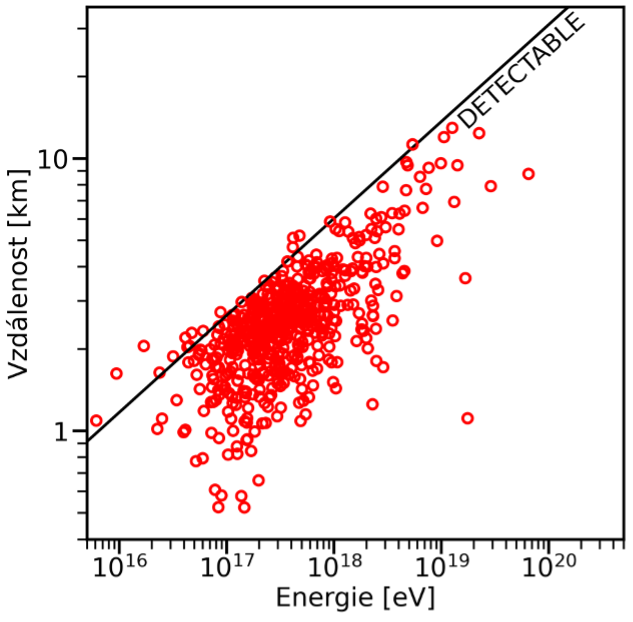
The study also provides a first estimate of the sensitivity of a FAST telescope in the Southern Hemisphere. According to the results, a FAST telescope should be capable of detecting particles with energies around 60 EeV at distances of up to 20 kilometers. This represents an important step toward enabling FAST to contribute to solving the long-standing question of the origin of the most energetic cosmic air showers.
The research was carried out by an international team, including scientists from Palacký University Olomouc and the Institute of Physics of the Czech Academy of Sciences, in collaboration with colleagues from Japan, the United States, Italy, and Germany.
[1] Kmec, J; Bořil, P; Bradfield, F; Černý, K; Chytka, L; Fujii, T; Horváth, P; Hrabovský, M; Jílek, V; Kvita, J; Mastrodicasa, M; Matthews, JN; Michal, S; Niechciol, M; Nožka, L; Palatka, M; Pech, M; Privitera, P; Salamida, F; Sakurai, S; Schovánek, P; Šmída, R; Svozilíková, Z; Tachibana, H; Taketa, A; Thomas, SB; Trávníček, P; Vacula, M; Záhora, J; Mandát, D; Hamal, P: Detection of ultra-high-energy cosmic rays in the southern hemisphere with FAST: Data acquisition and preliminary results,Results Eng. 30 (2026), 110063. DOI 10.1016/j.rineng.2026.110063.